
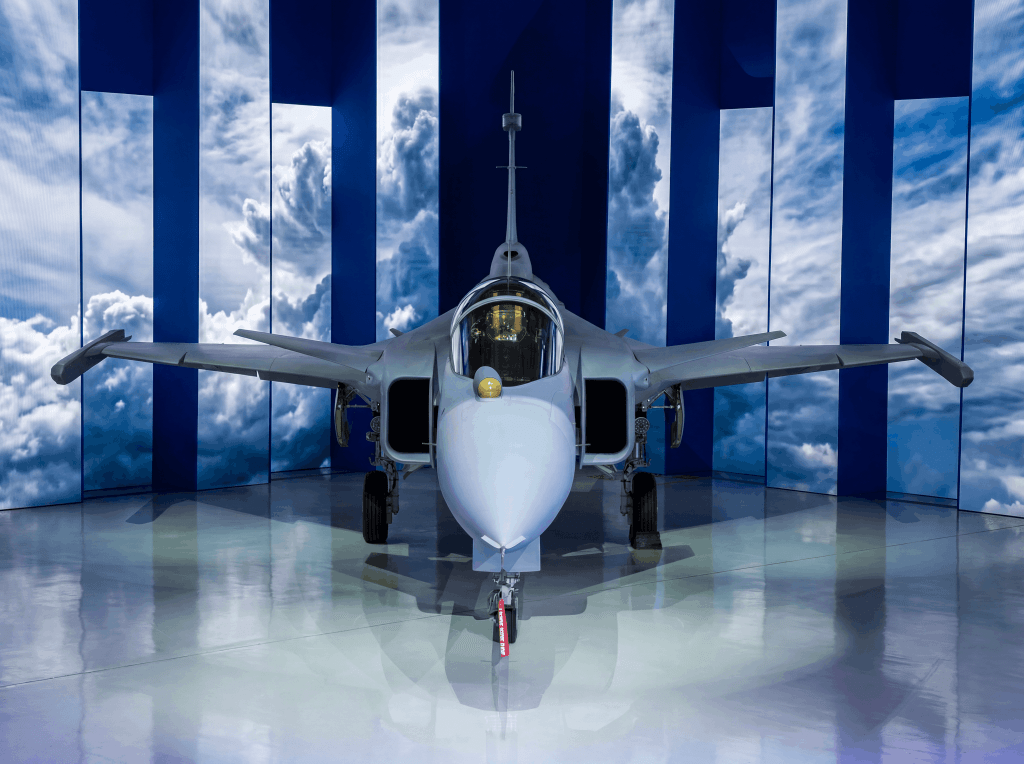
Photo credit: Embraer
In a landmark moment for Brazil’s aerospace and defense industry, Embraer, Saab and the Brazilian Air Force officially unveiled the first supersonic fighter aircraft produced in Brazil. The ceremony, held at Embraer’s industrial complex in São Paulo State, marks a major step forward in the country’s ambition to develop sovereign high-technology defense capabilities.
The rollout of the locally produced Saab JAS 39 Gripen E underscores the strength of the long-standing partnership between Brazil and Sweden, combining industrial cooperation, technology transfer, and operational capability into a single strategic program.
The event brought together high-level political, diplomatic and military leadership, including President Luiz Inácio Lula da Silva, as well as senior representatives from both nations and industry. Their presence highlighted the geopolitical and industrial importance of the program.
Speaking at the ceremony, Bosco da Costa Junior emphasized the significance of developing advanced fighter aircraft production capabilities within Brazil, noting that the program strengthens national sovereignty while enabling the country to operate cutting-edge systems tailored to its defense needs.
Micael Johansson described the milestone as a testament to a partnership built on trust and long-term cooperation, reaffirming Saab’s commitment to expanding its industrial footprint in Brazil and supporting the country’s emergence as a global aerospace hub.
At the heart of the program lies Embraer’s Gavião Peixoto facility, now one of the few sites worldwide capable of producing modern supersonic combat aircraft. The production process integrates a hybrid supply chain, combining Brazilian industrial capacity with international expertise. Aerostructures are manufactured at Saab’s Brazilian facility in São Bernardo do Campo, further embedding advanced manufacturing know-how within the national ecosystem.
Before entering operational service, each aircraft undergoes a rigorous sequence of functional testing and production flight trials. Following certification, the fighter will be delivered to the Brazilian Air Force and integrated into frontline units.
The Gripen fleet is based at Anápolis Air Force Base, home of the 1st Air Defense Group (1st GDA), where the aircraft is already conducting Quick Reaction Alert (QRA) missions. These operations ensure continuous protection of Brazil’s sovereign airspace, including the federal capital region.
The Gripen E represents the latest evolution in multirole combat aircraft design, optimized for modern, high-threat environments. Its capabilities span the full spectrum of air operations, including:
Air superiority and air defense
Precision strike missions
Tactical reconnaissance
Central to its effectiveness is a network-centric architecture, enabling seamless data exchange across platforms and formations. Advanced sensor fusion integrates inputs from radar, electronic warfare systems, and other onboard sensors, delivering enhanced situational awareness and faster decision-making cycles for pilots.
The aircraft’s open architecture and modular design also ensure adaptability, allowing continuous upgrades in response to evolving operational requirements.
The Gripen program in Brazil is anchored in a 2014 contract with the Brazilian government, covering the development and production of 36 aircraft:
28 Gripen E (single-seat variants)
8 Gripen F (two-seat variants, under development)
Deliveries began in 2020, with 10 aircraft already handed over to the Brazilian Air Force. The newly unveiled aircraft is the first to be produced in Brazil, with an additional 14 units expected to follow under the same industrial model.
Beyond its immediate operational value, the Gripen program represents a benchmark for international defense collaboration. Through comprehensive technology transfer and local production, Brazil is not only acquiring advanced combat aircraft but also building a sustainable industrial base capable of supporting future aerospace programs.
For Saab, the partnership strengthens its global presence and establishes Brazil as a strategic production and export hub in Latin America. For Brazil, it marks a decisive step toward greater defense autonomy and industrial competitiveness.
The rollout of the first Brazilian-produced Gripen fighter is more than a symbolic achievement—it is a concrete demonstration of how strategic partnerships, when built on trust and shared vision, can deliver both operational capability and long-term industrial value.
As production continues and additional aircraft enter service, the program is set to play a central role in shaping Brazil’s defense posture and its position within the global aerospace landscape.
 DBDC INTERNATIONAL DEFENCE PUBLICATIONS & EVENTS UK LTD
Leave a comment