Photo credit: AFRICOM
A recent military-to-military engagement between United States Africa Command (AFRICOM) and the Armed Forces of Côte d’Ivoire has underscored the growing importance of logistics modernisation as a key driver of operational readiness across West Africa. Conducted from 10 to 13 March 2026, the engagement brought together U.S. military logisticians and their Ivorian counterparts in a focused effort to enhance vehicle maintenance capabilities and improve supply chain efficiency, both of which are critical to sustaining military operations in complex environments.
The visit formed part of an ongoing cooperation framework aimed at strengthening regional partners’ ability to operate independently and respond effectively to evolving security challenges. Building on previous in-country assessments, the engagement highlighted measurable progress achieved by the Ivorian Armed Forces, particularly in the development of structured logistics processes and institutional improvements. Over the past year, collaboration between AFRICOM and Côte d’Ivoire has contributed to tangible advancements, including the drafting of a joint logistics doctrine designed to standardise procedures and improve coordination across units.
Rather than relying on costly equipment upgrades or large-scale investments, the initiative places emphasis on high-impact, low-cost solutions that can be implemented rapidly. Improvements in data analysis, the standardisation of maintenance procedures, and the optimisation of repair workflows have already demonstrated significant benefits, enhancing the efficiency and sustainability of existing capabilities. This approach reflects a broader shift in military support strategies, where procedural refinement and organisational effectiveness are increasingly recognised as force multipliers.
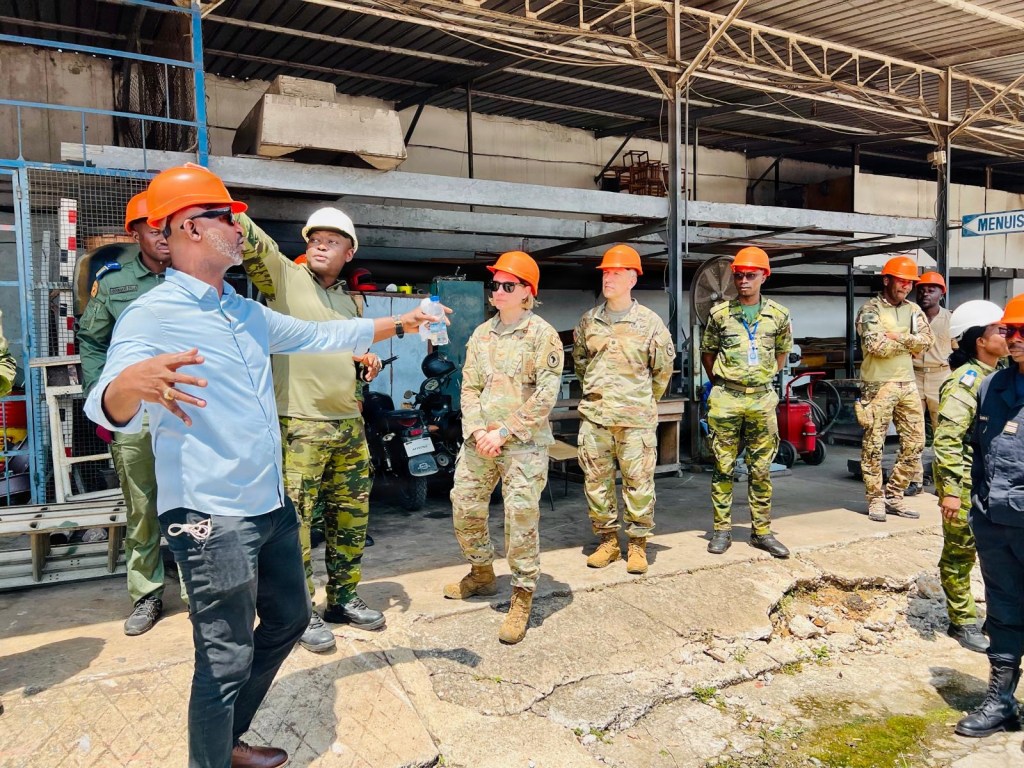
During the four-day engagement, the Ivorian Armed Forces provided a comprehensive overview of their logistics structure, including current maintenance policies and recent enhancements. Joint teams conducted site visits to key facilities across the Army, Navy and Ministry of Defence, allowing for a detailed assessment of repair capabilities at different operational levels. Army workshops demonstrated both intermediate-level repair facilities capable of handling major maintenance tasks and more advanced workshops equipped for complete vehicle overhauls and reconstruction. Similarly, the Navy presented its most sophisticated maintenance facility, capable of supporting complex and demanding repair requirements, while Ministry of Defence workshops illustrated the integration of logistics support across both military and government vehicle fleets.
These inspections enabled AFRICOM specialists to identify remaining capability gaps and propose targeted, practical solutions aimed at further strengthening operational sustainability. The findings reinforced the central role of logistics in military effectiveness, highlighting that the ability to maintain and support equipment in the field is as critical as the platforms themselves. By improving maintenance systems and supply chain resilience, Côte d’Ivoire is enhancing its capacity to sustain operations independently, reducing reliance on external assistance and increasing overall readiness.
The engagement also reflects the United States’ broader strategic objective in Africa, which focuses on building the capacity of regional partners to address their own security challenges. In an increasingly complex security environment, characterised by asymmetric threats and the need for rapid, adaptable responses, strengthening foundational capabilities such as logistics is essential. For Côte d’Ivoire, continued progress in this domain not only improves national defence readiness but also contributes to regional stability by enabling more effective participation in security operations.
Ultimately, the collaboration demonstrates that meaningful improvements in military capability do not always require significant financial investment. Instead, targeted adjustments to processes, better use of data, and enhanced coordination can deliver immediate and lasting operational benefits. As such initiatives continue, they are likely to play an increasingly important role in shaping the effectiveness and resilience of partner forces across the African continent.
 DBDC INTERNATIONAL DEFENCE PUBLICATIONS & EVENTS UK LTD
Leave a comment