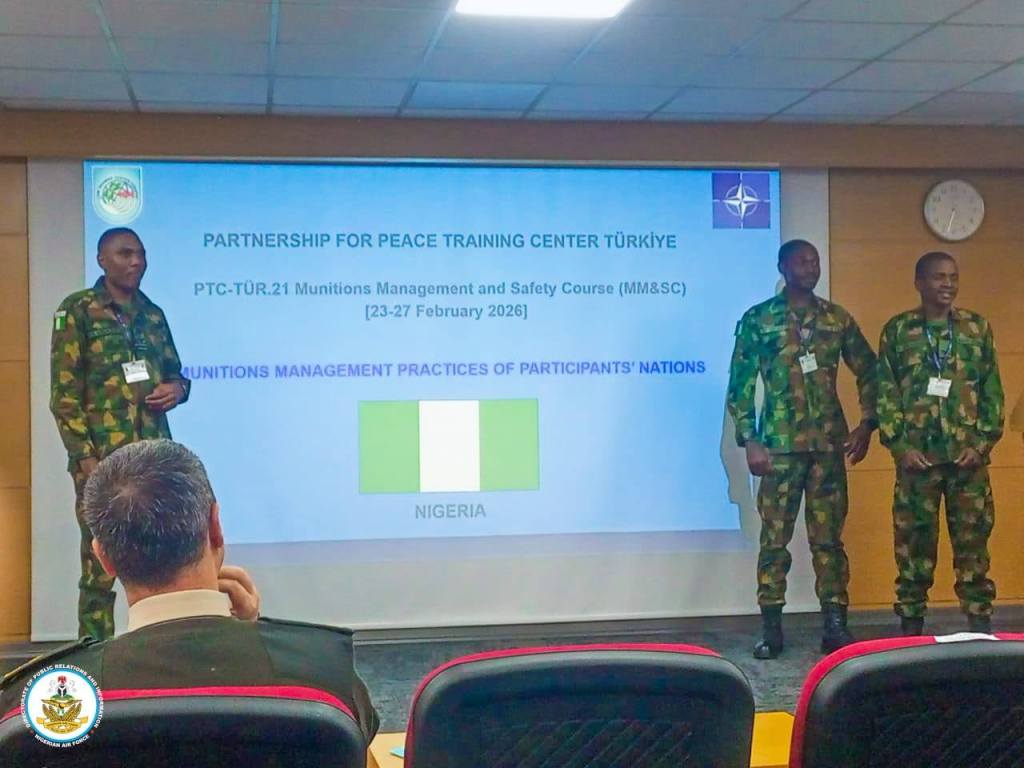
The Nigerian Air Force (NAF) has taken another step toward strengthening its operational safety architecture through participation in a high-level international training programme in Türkiye. From 23 to 27 February 2026, three NAF officers attended the Munitions Management and Safety Course at the Turkish Partnership for Peace Training Centre in Ankara, joining 22 other military personnel from 13 additional countries.
The course brought together 25 participants from 14 nations, underscoring its multinational character and the growing emphasis on shared standards in munitions safety and management. For the NAF, the engagement reflects a deliberate policy of expanding international professional military education and aligning national procedures with globally recognized best practices.
Throughout the week-long programme, participants were immersed in United Nations and NATO doctrines, terminologies, and regulatory frameworks governing the storage, handling, transportation, and disposal of munitions. Particular emphasis was placed on safety protocols, risk mitigation strategies, and compliance mechanisms designed to reduce accidents and enhance accountability in military stockpile management.
Structured syndicate sessions and moderated group discussions enabled officers to exchange perspectives on national systems and operational procedures. This collaborative format fostered not only technical learning but also interoperability awareness—an increasingly vital component in multinational peace support operations and coalition environments. By comparing safety architectures and regulatory models, participants gained a broader understanding of how munitions management practices can be harmonized across different defence establishments.
The training also examined emerging technologies and evolving global trends in munitions safety architecture. Discussions addressed advancements in digital tracking systems, improved storage infrastructure, and enhanced monitoring protocols aimed at strengthening transparency and lifecycle management of ammunition stockpiles. Exposure to these developments provided participants with updated technical insights aligned with contemporary international standards.
For the Nigerian Air Force, the initiative fits squarely within the command philosophy of the Chief of the Air Staff, Air Marshal Sunday Kelvin Aneke, who has consistently emphasized deliberate training, international collaboration, and sustained professional development as critical pillars of operational effectiveness. By investing in structured global engagements, the Service continues to position itself as a forward-looking institution committed to safety, discipline, and mission readiness.
Beyond technical proficiency, the course offered strategic value by reinforcing professional networks among partner nations. Such relationships often serve as foundations for future cooperation, knowledge sharing, and coordinated approaches to shared security challenges. In an era where safety lapses in munitions management can have far-reaching humanitarian and operational consequences, the importance of standardized procedures and well-trained personnel cannot be overstated.
Through its participation in this multinational programme in Ankara, the Nigerian Air Force has demonstrated a clear commitment to maintaining globally benchmarked safety standards. As defence institutions increasingly operate within interconnected security environments, sustained engagement in international training platforms remains essential for building resilient, professional, and interoperable air forces.
© Nigerian Air Force


Leave a Reply