Image copyright: AFRICOM
Ghana and the United States are strengthening maritime security cooperation as Accra continues to expand its role as a key West African partner in protecting the Gulf of Guinea, with growing emphasis on operational readiness, maritime domain awareness, information sharing and regional coordination.
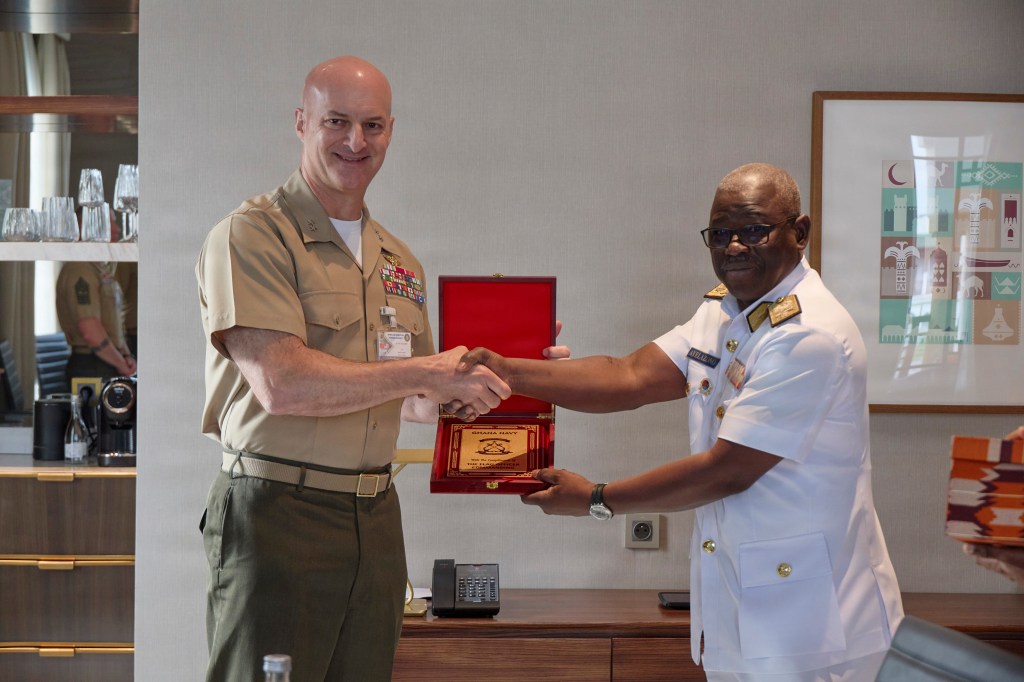
Ghanaian maritime leaders met with U.S. Marine Corps Forces, Europe and Africa (MARFOREUR/AF) during the African Maritime Forces Summit (AMFS) 2026, held in Rabat, Morocco, to discuss shared security priorities and the development of capabilities required to address increasingly complex threats along the West African coastline.
The discussions are significant beyond the bilateral Ghana–U.S. relationship. Ghana occupies an important position on the Gulf of Guinea, a maritime area of major economic and strategic importance that supports international shipping, energy infrastructure, fisheries and regional trade.
Despite improvements in the regional piracy environment compared with previous years, West African maritime forces continue to confront a diverse threat spectrum encompassing piracy and armed robbery at sea, illicit trafficking, illegal fishing and other forms of transnational maritime crime.
This evolving operating environment is placing greater emphasis on the ability of coastal states not simply to acquire patrol platforms, but to develop an integrated maritime security architecture combining surveillance, intelligence, secure communications, command-and-control systems and rapid-response capabilities.
For Washington, Ghana represents an increasingly important security partner capable of contributing both nationally and regionally to maritime stability.
U.S. Marine Corps Forces, Europe and Africa and Ghanaian forces have developed their relationship through bilateral engagements, multinational exercises and professional military exchanges. These activities contribute to improving operational readiness while strengthening interoperability between Ghanaian forces and international partners.
Particular importance is attached to specialized capabilities such as those maintained by the Ghanaian Special Boat Squadron, which can provide a rapid-response capability against maritime threats and support more complex interdiction and coastal security missions.
“Ghana is a capable maritime partner whose leadership in the Gulf of Guinea strengthens security beyond its own coastline. Our cooperation is focused on the readiness, relationships and regional coordination partners need to protect their waters and respond to shared threats,” said Maj. Gen. Daniel L. Shipley, Commander of U.S. Marine Corps Forces, Europe and Africa.
The emphasis on Ghanaian leadership is particularly relevant to the developing security architecture of the Gulf of Guinea. Maritime threats rarely remain confined within national territorial waters, making information exchange and operational coordination between neighbouring countries essential.
The Ghana–U.S. engagement also reflects a wider transformation taking place across African maritime security.
For defence and security suppliers, the requirement is increasingly shifting toward interconnected systems capable of detecting, identifying, tracking and responding to threats across large maritime areas.
Coastal and maritime surveillance radars, electro-optical sensors, unmanned aerial systems, secure tactical communications, command-and-control solutions and maritime domain awareness platforms are consequently becoming increasingly important elements of coastal security.
Unmanned systems could assume a particularly important role. Persistent surveillance using UAS can complement conventional patrol aircraft and naval vessels by providing comparatively flexible coverage of coastal areas and supporting the identification of suspicious vessels before surface assets are deployed.
Equally important is the integration of information generated by different sensors and agencies. Effective maritime security depends increasingly on the ability to transform surveillance data into actionable intelligence and rapidly distribute that information to naval, coast guard and other security units.
For countries such as Ghana, this creates a requirement not simply for additional equipment, but for integrated solutions combining technology with training, maintenance, operational doctrine and long-term support.
The United States’ continuing engagement with Ghana should therefore be viewed within the wider strategic importance of West African maritime security.
The Gulf of Guinea connects several of Africa’s important coastal economies with global maritime trade. Disruption caused by piracy, trafficking, illegal fishing or instability can have consequences extending beyond the immediate coastal states.
At the same time, international partners increasingly emphasize African-led security solutions rather than permanent external deployments. Developing capable national forces that can operate independently while coordinating with neighbouring states is therefore becoming a central component of regional maritime security strategy.
AMFS 2026 provided another platform for advancing this approach, bringing African maritime leaders together with international partners to examine operational, technological and regional responses to common threats.
For Ghana, deeper cooperation with the United States provides access to training, operational experience and opportunities to strengthen interoperability. For Washington, a capable Ghanaian maritime force contributes to a broader network of regional partners able to protect strategically important waters without requiring continuous external intervention.
The Ghana–U.S. relationship consequently represents more than bilateral military cooperation. It forms part of the continuing development of a regional maritime security architecture in the Gulf of Guinea, in which surveillance technology, specialized maritime forces, information sharing and multinational coordination will increasingly determine the ability of West African states to secure their waters and protect the region’s maritime economy.
Source: U.S. Marine Corps Forces, Europe and Africa / African Maritime Forces Summit 2026


Leave a Reply