
Image copyright: U.S. Africa Command Public Affairs
Morocco and U.S. Africa Command (AFRICOM) have taken a significant step toward creating a new regional hub for multidomain training, unmanned systems, experimentation and defence-industrial cooperation in Africa.
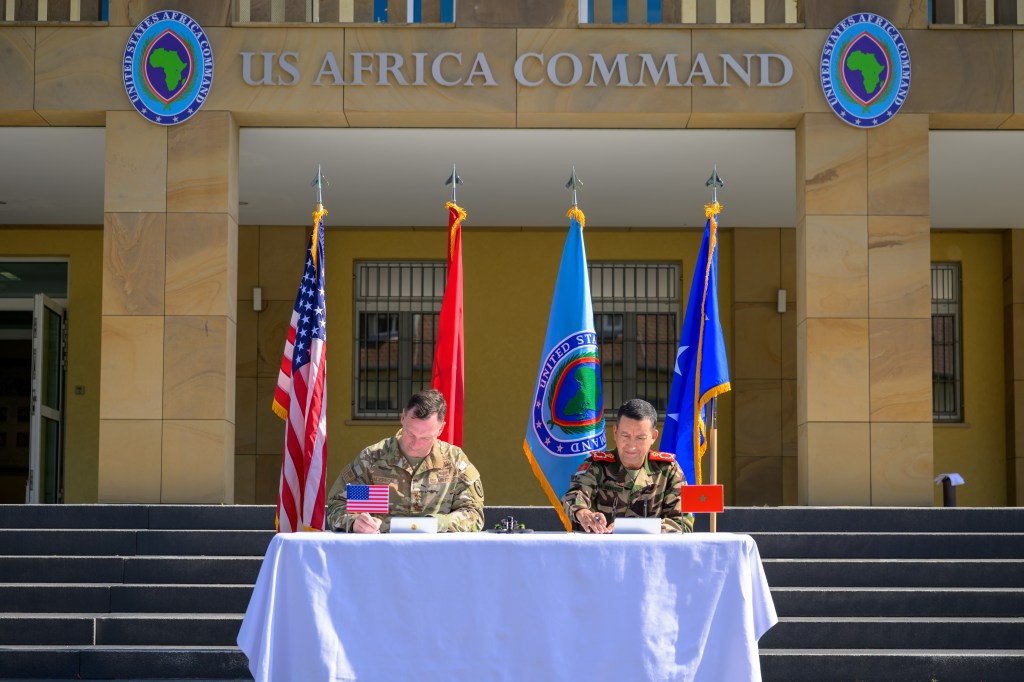
The Royal Moroccan Armed Forces and U.S. Africa Command signed a memorandum of understanding at AFRICOM Headquarters in Stuttgart on 13 July 2026, seeking to establish the Africa Multidomain Training and Experimentation Center (AMTEC) in Morocco.
Planned to be established by 2030 in Tan-Tan, AMTEC will comprise three principal elements: a Multidomain Training Area, a Drone Academy, and an Innovation and Experimentation Center. Together, these facilities are intended to provide an advanced environment for training African forces while also allowing emerging defence technologies and operational concepts to be tested under realistic conditions.
The initiative represents another important development in Morocco’s expanding role as a key U.S. defence and security partner in North Africa. The planned Multidomain Training Area will provide dedicated facilities where forces and military systems can prepare to operate across different domains and in increasingly complex operational environments. Of particular significance will be its capacity to support activities across the full electromagnetic spectrum and under contested conditions, reflecting the growing importance of electronic warfare, resilient communications, sensor integration and multidomain command and control in modern operations.
A central component of AMTEC will be the Drone Academy, which is expected to train operators, planners and instructors from Morocco and other African partner nations. Training will focus on integrating small unmanned aerial systems into military operations, including airspace deconfliction, multidomain integration, strike capabilities and the synchronization of intelligence, surveillance and reconnaissance missions.
The emphasis on unmanned systems reflects their rapidly expanding importance in African security operations, particularly against terrorist and other asymmetric threats in West Africa. Armed forces operating across the continent increasingly require affordable and adaptable systems capable of persistent surveillance, reconnaissance, target identification and operational support over large and often difficult-to-access territories.
AMTEC will also have an important defence-industrial dimension. Its Innovation and Experimentation Center is intended to accelerate the development, testing and evaluation of emerging capabilities, with particular emphasis on affordable and scalable technologies applicable to counterterrorism and regional security missions. Cooperation is expected to involve not only military organizations but also U.S. and Moroccan defence companies and academic institutions.
“Morocco’s readiness—demonstrated by our existing facilities and skilled personnel—ensures rapid progress from concept to operational reality and provides the Morocco and U.S. industries with a reliable and capable partner for joint innovation and export opportunities,” said Gen. Mohammed Berrid, Inspector General of the Royal Moroccan Armed Forces and Commander of the Southern Zone.
For defence manufacturers, AMTEC could consequently develop into an important African test and evaluation environment for unmanned and autonomous platforms, artificial intelligence-enabled systems, advanced communications, sensors, wireless technologies and other emerging capabilities. Testing systems under operational conditions relevant to African armed forces could also help manufacturers adapt technologies to specific regional requirements while potentially reducing development and evaluation costs.
Gen. Dagvin Anderson, Commander of U.S. Africa Command, described the project as an opportunity for both U.S. and African defence industrial bases, as well as academic institutions, to experiment and develop scalable and adaptable solutions across emerging technologies.
The annual African Lion 2027 exercise is expected to serve as a proof of concept for AMTEC. The exercise will provide an operational environment in which industry and military personnel can evaluate AI-enabled systems, autonomous platforms and advanced communications technologies and accelerate their transition from experimental concepts to deployable capabilities.
If implemented as planned, AMTEC could therefore become considerably more than a military training facility. It has the potential to establish Morocco as an increasingly important African centre for defence experimentation, unmanned systems training and technological innovation, while creating new opportunities for cooperation between African, Moroccan and U.S. armed forces, defence industries and research institutions.


Leave a Reply