
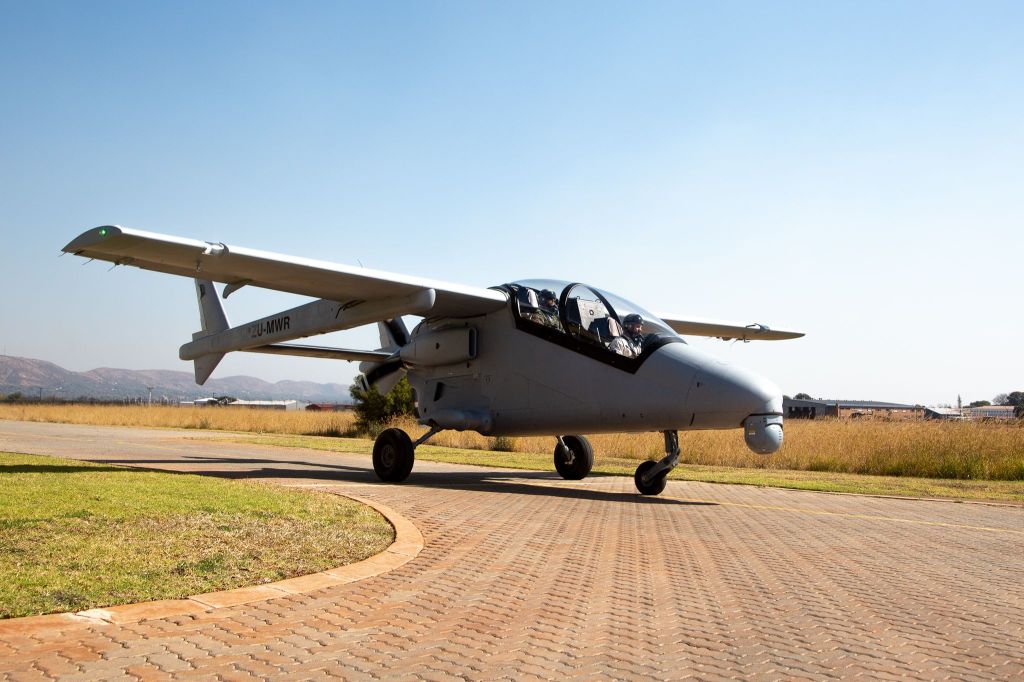
© Image copyright: Paramount Aerospace Industries
Paramount Aerospace Industries has further strengthened the Counter-Unmanned Aircraft System (C-UAS) capabilities of its South African-designed Mwari multi-mission aircraft through the integration of ASELSAN’s advanced ASELFLIR-500 electro-optical reconnaissance, surveillance and targeting system. The integration forms part of a strategic collaboration between Paramount Aerospace Industries and ASELSAN and represents a significant enhancement of the Mwari’s dedicated Counter-UAS configuration. The combination is intended to improve the aircraft’s ability to detect, identify, classify, track and support the engagement of small and fast-moving aerial threats. “Success depends on the ability to detect, identify, classify, track and engage small, fast-moving aerial targets quickly and accurately. The ASELFLIR-500 significantly enhances Mwari’s ability to deliver that complete capability from a single airborne platform”, said Lee Connolly, CEO of Paramount Aerospace Industries.
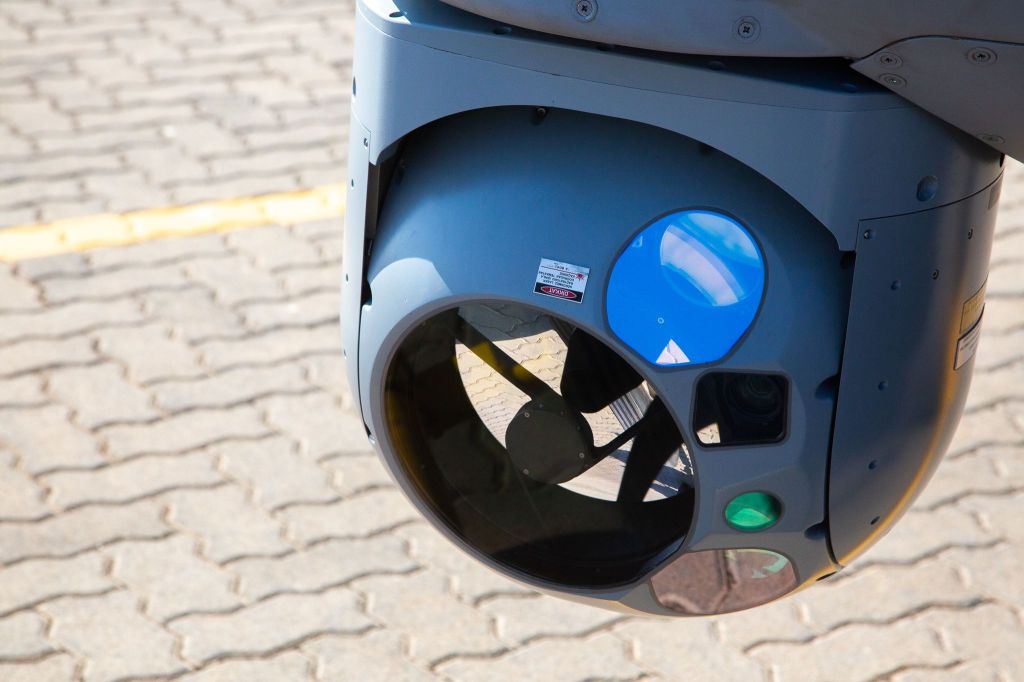
Developed by ASELSAN, the ASELFLIR-500 is a high-performance, 15-inch-class electro-optical reconnaissance, surveillance and targeting system developed for fixed-wing aircraft and unmanned aerial vehicles. At the heart of the system is a 220 mm common optical aperture designed to provide high-quality imagery and extended-range performance. Its sensor package combines a 1280 × 1024 mid-wave infrared (MWIR) camera, a 1920 × 1080 HD daylight television camera and a 1280 × 1024 short-wave infrared (SWIR) camera. The system provides 360-degree continuous azimuth coverage and an elevation field of regard from +90 to -90 degrees. Its integrated laser rangefinder and target designator operates at 1064 nm and has a stated range of up to 35 km, while the system also incorporates a near-infrared/SWIR laser pointer compatible with night-vision equipment. Of particular relevance to Counter-UAS operations are ASELFLIR-500’s advanced image-processing and tracking capabilities. ASELSAN lists AI-based image processing, multi-target tracking, simultaneous tracking using IR, daylight and SWIR imagery, accurate target geolocation, and determination of the course and speed of moving targets among the system’s capabilities. The 54 kg sensor also incorporates an inertial measurement unit and high-accuracy stabilisation. These characteristics are particularly important against small UAS targets, where rapid detection must be followed by reliable identification and continuous tracking before an engagement decision can be made.
Designed and manufactured in South Africa by Paramount Group, the Mwari is a two-crew intelligence, surveillance and reconnaissance (ISR), C4ISR and precision-strike aircraft designed around an open architecture that enables sensors, communications equipment, mission systems and weapons to be integrated according to operational requirements. A central feature of the aircraft is its modular mission-system architecture. The Mwari incorporates an interchangeable mission bay, allowing different sensors and payloads to be fitted without requiring a dedicated aircraft for every operational role. Paramount has previously stated that its Interchangeable Mission Systems Bay can allow sensor and payload configurations to be exchanged in less than two hours. The aircraft’s current published specifications include a maximum cruise speed of approximately 230 knots, a service ceiling of 21,000 ft, a maximum range of 1,300 nautical miles using internal fuel and up to 2,000 nautical miles with external fuel. Endurance with internal fuel is listed at seven hours, while maximum payload with full fuel is approximately 800 kg.
Its rugged undercarriage and short-field characteristics allow operations from austere locations with comparatively limited logistical infrastructure. The aircraft also provides six under-wing hardpoints and can accommodate different weapon configurations, including cannon pods, guided rockets, guided munitions and anti-tank guided missiles. Counter-UAS is not an entirely new role for the Mwari. Paramount has previously developed the aircraft’s anti-drone capabilities around the combination of persistent airborne surveillance, multi-spectrum sensors, data links and airborne effectors. Previous Counter-UAS configurations have included multi-role air-to-air missiles alongside rapid-fire wing-mounted cannon pods. Paramount has also highlighted the aircraft’s ability to combine long-range optical and radar surveillance, multi-spectrum search-and-track sensors, high-bandwidth data links and real-time video within a single airborne system. The addition of the ASELFLIR-500 significantly strengthens the sensor component of this architecture.


Leave a comment