
© Images copyright: John Cockerill Defense
John Cockerill Defense has outlined a range of counter-drone systems for armoured vehicles, combining remote-controlled weapon stations with radar, radio-frequency countermeasures and automated detection technologies. Announced in connection with Eurosatory 2026, the developments address the growing requirement to protect vehicles against unmanned aerial threats while retaining their existing combat roles. The proposed configurations cover troop carriers, reconnaissance vehicles and platforms equipped with medium- and large-calibre turrets. Rather than relying on a single interception method, the approach combines different detection and engagement capabilities across several weapon systems. The programme includes experimental work with French defence authorities, equipment developed with industrial partners and a new turret-based concept intended to extend protection across a wider range of armoured platforms.
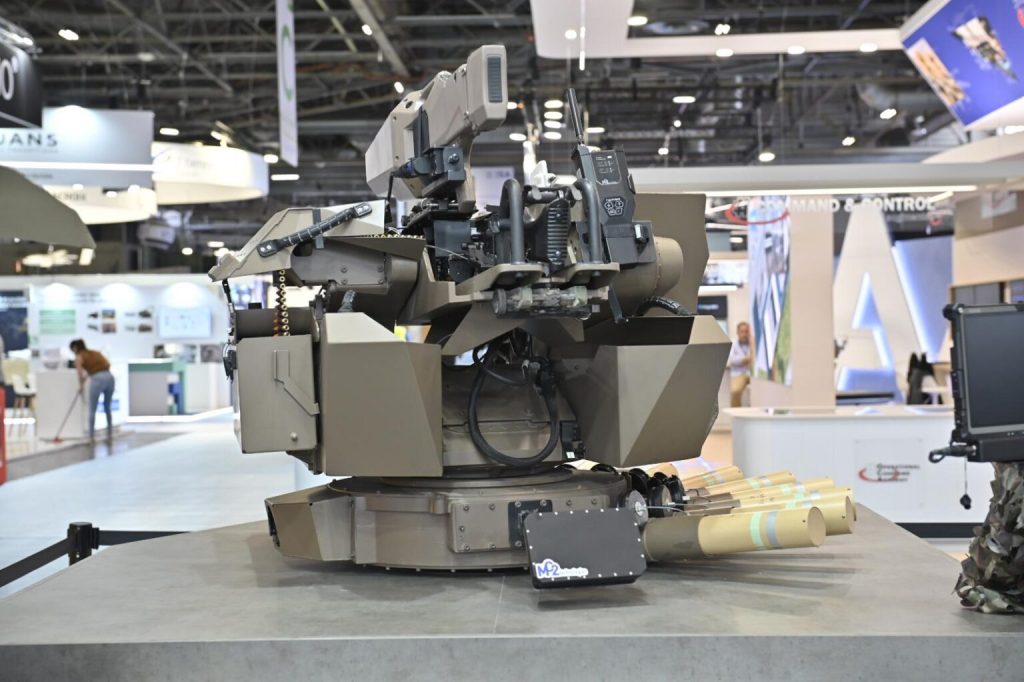
One of the principal developments is the Operational Adaptation Kit for Counter-UAV, known as KAO LAD, integrated into a T1 Hornet remote-controlled turret mounted on a Serval 4×4 armoured vehicle. The experimental configuration was developed through cooperation between John Cockerill Defense, the French defence procurement agency, DGA, and the French Army Technical Section, STAT. It combines a radar system with an adapted fire-control solution, allowing the turret to support drone detection and engagement. The French Ministry of Defence was scheduled to present the configuration at Eurosatory. The project illustrates an effort to incorporate counter-drone functions into an existing vehicle-mounted weapon station, potentially broadening its protective role. However, the announcement did not disclose engagement ranges, interception rates or details of the conditions under which the configuration had been tested.
A related configuration, designated Hornet Air Guard, was described by the company as an operational version featuring enhanced detection and radio-frequency neutralisation capabilities developed with MC2. John Cockerill Defense announced that the system would appear on its own exhibition stand, with three additional examples displayed by MBDA, Thales and AM General. These planned presentations placed the system within several industrial settings, although the announcement did not specify procurement commitments associated with those appearances. Alongside Hornet Air Guard, the company introduced the Hornet S Air Guard concept, based on the Hornet S or T3 turret family, including turrets used on the Jaguar reconnaissance vehicle. This concept is intended to provide 360-degree detection for medium- and large-calibre turrets, extending the proposed counter-drone architecture beyond troop transport vehicles to other armoured combat platforms.
The broader offering also incorporates internally developed artificial-intelligence technologies for automatic drone detection and tracking, together with an adaptation of the CLWS turret armed with a 25 mm cannon for dedicated counter-drone missions. These elements represent different parts of the detection, tracking and engagement process, with their practical value dependent on how effectively they are integrated on each vehicle. John Cockerill Defense presented ease of integration and deployment as objectives of the range, but provided no detailed implementation schedules or comparative performance data. The announcement therefore sets out the scope of the company’s counter-drone portfolio rather than establishing the operational effectiveness of every configuration. Further testing, integration work and procurement decisions will determine how these systems contribute to vehicle protection and which configurations ultimately enter wider military service.


Leave a Reply