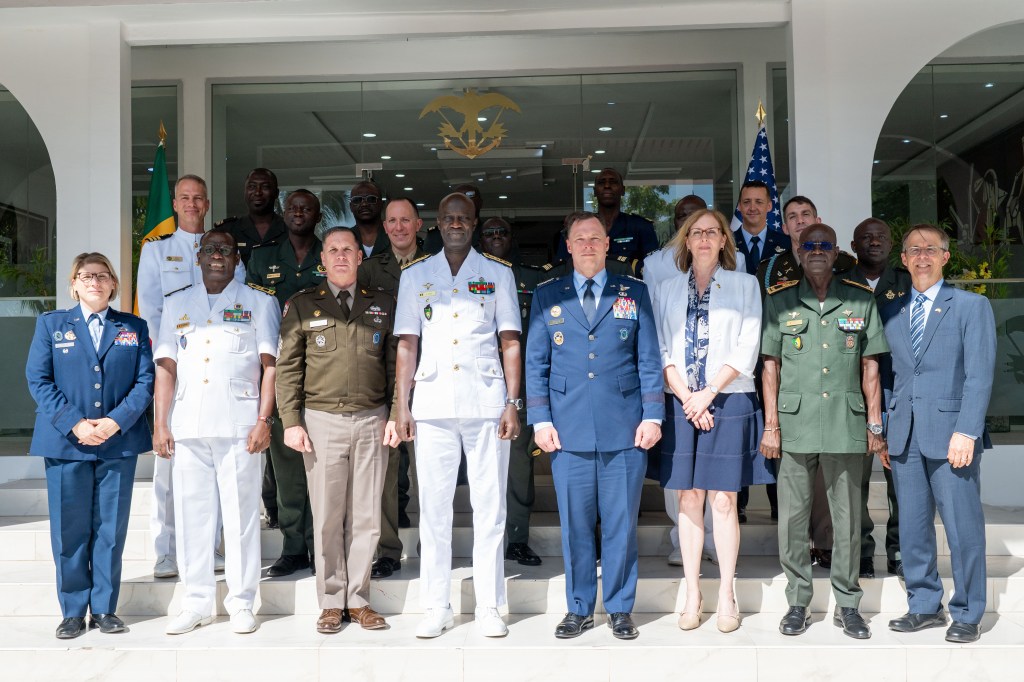
U.S. Air Force Gen. Dagvin Anderson, commander of U.S. Africa Command, and Senegal Vice Adm. Oumar Wade, chief of defense staff of the Armed Forces of Senegal, walk through Camp Dial Diop, Dakar, Senegal, Nov. 12, 2026, after an official office call. The leaders exchanged perspectives on regional security challenges and discussed opportunities to enhance coordination between the U.S. and Senegal. (U.S. Army photo by Sgt. 1st Class Kenneth Tucceri, AFRICOM public affairs)ovember 2026
The Commander of United States Africa Command (AFRICOM), U.S. Air Force General Dagvin Anderson, concluded a high-level diplomatic and military engagement across Mali and Senegal from 10 to 12 November 2026, reaffirming Washington’s commitment to strengthening regional security partnerships, counterterrorism cooperation and strategic stability in West Africa. The visit reflected ongoing American efforts to engage African governments in addressing the growing threat posed by violent extremist organisations operating across the Sahel, while exploring opportunities for enhanced defence cooperation and regional security coordination. Anderson began his engagements in Bamako on 10 November, where he held bilateral discussions with Mali’s transitional president, Assimi Goïta, marking his first official visit to the country since assuming command of AFRICOM. Their discussions focused on identifying shared security priorities and assessing potential areas of cooperation, particularly in confronting Jama’at Nusrat al-Islam wal-Muslimin (JNIM) and Islamic State in the Sahel, two extremist organisations responsible for persistent insecurity across parts of the region. Anderson emphasised the United States military’s specialised counterterrorism capabilities, including intelligence analysis, surveillance expertise and the ability to monitor extremist communications, recruitment activities and financial networks associated with organisations such as ISIS and al-Qaida. He highlighted how American operational experience and technical resources could assist regional partners in understanding evolving terrorist threats and developing more effective responses. The discussions also addressed broader regional security dynamics and the importance of maintaining constructive international partnerships based on shared interests and mutual security objectives. Anderson reiterated AFRICOM’s willingness to cooperate with governments prepared to address common security challenges, underscoring the strategic importance of collaboration in responding to threats that extend beyond national borders. During his stay in Mali, the AFRICOM commander attended the BAMEX defence exhibition, where he interacted with American and African defence industry representatives to explore developments in military technology, defence innovation and security cooperation. His visit also included a culturally significant engagement at the Mamma Haidara Commemorative Library, where he met founder Dr. Abdel Kader Haidara and recognised the extraordinary civilian operation undertaken in 2012 to protect more than 350,000 medieval manuscripts from extremist destruction during the occupation of Timbuktu. The preservation effort safeguarded invaluable records of Africa’s scientific, legal, intellectual and literary heritage, demonstrating the importance of protecting cultural institutions amid armed conflict. Following his engagements in Mali, Anderson travelled to Dakar, Senegal, where he met senior government and military officials on 11 and 12 November, including Minister of the Interior and Public Safety Mouhamadou Makhtar Cisse, Minister of Armed Forces Yankoba Dieme and Chief of Defence Staff Vice Admiral Oumar Wade. These meetings reaffirmed the longstanding defence relationship between the United States and Senegal, which has developed over approximately six decades through military training, institutional cooperation and regional security initiatives. Discussions concentrated on maritime domain awareness, cybersecurity, counterterrorism and strengthening Senegalese security capabilities, particularly along the country’s eastern border. Both sides highlighted existing cooperation through the Vermont State Partnership Program, professional military education opportunities for Senegalese officers and Senegal’s participation in international naval activities, including the International Naval Review associated with the America 250 celebrations. Anderson also visited the Bargny-Sendou Port development site, approximately 25 kilometres south of Dakar, a major infrastructure project envisioned as West Africa’s largest bulk cargo port and previously supported by an initial three-million-dollar grant from the U.S. Trade and Development Agency. The port visit highlighted the relationship between strategic infrastructure development, commercial connectivity and regional economic security. Overall, Anderson’s engagements in Mali and Senegal demonstrated AFRICOM’s continuing emphasis on security cooperation, counterterrorism partnerships and diplomatic engagement as essential instruments for addressing instability across West Africa. The mission also illustrated Washington’s interest in maintaining dialogue with diverse regional governments while reinforcing established military partnerships and exploring opportunities to support long-term peace, security and development throughout the Sahel and the wider West African region. (Sourse: AFRICOM)


Leave a Reply